

A patient calls at 11pm with a swollen face. By morning, the message is buried in voicemail, the patient has gone to a competitor, and the practice has lost €500 or more. We're seeing this pattern across European dental clinics, where the gap between night call and morning chair costs real revenue. NHS England's 60-minute triage standard for emergency cases sets a clear benchmark, yet most practices still rely on fragmented handoff processes that let urgent inquiries slip through the cracks.
The real problem: What happens between the night call and morning chair
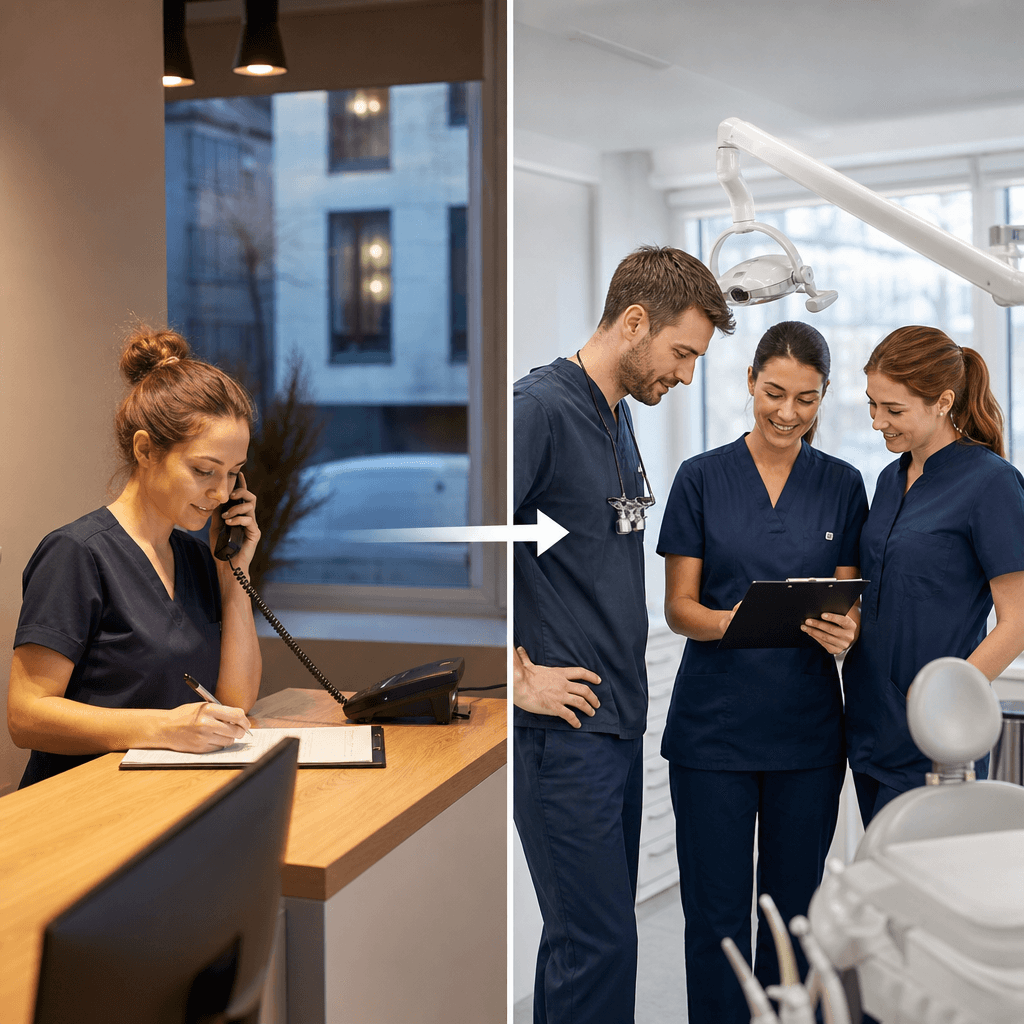
The core issue isn't clinical skill or even technology. It's operational choreography. The receptionist who answers at 9pm is rarely the clinician who treats at 9am, and that gap creates friction. Notes get lost. Urgency gets downgraded. Patients get frustrated and leave.
We're tracking consistent revenue losses of €300 to €800 per missed emergency call across European practices. Multiply that across evenings and weekends, and the annual impact runs into tens of thousands. The patient with the swollen face doesn't wait. They search, they call a competitor, they book elsewhere.
The person who takes the call is almost never the person who treats the patient. That's the gap where revenue disappears.
What separates high-performing practices from the rest? Handoff choreography. The structured documentation, pre-scheduling slots, and confirmation loops that turn overnight decisions into morning actions. Managing emergency dental calls effectively depends less on who answers and more on what happens next.
Documentation of triage decisions protects practices legally while giving morning staff the context they need to act quickly. Facial swelling near the throat, uncontrolled bleeding, traumatic tooth loss. These aren't judgment calls at 8am. They're already documented, already scheduled, already in motion.
The focus here: building shift-to-shift protocols that protect revenue through ritual, not reactivity.
Using the three-tier timing framework as scheduling architecture
Clinical guidance from NHS England and the Scottish Dental Clinical Effectiveness Programme outlines a three-tier system that doubles as scheduling logic. Sixty minutes for true emergencies, 24 hours for urgent care, seven days for non-urgent follow-ups. Most practices treat this as clinical advice. High performers treat it as calendar architecture.
The operational translation looks like this: morning emergency slots held specifically for overnight 60-minute cases, same-day flex slots reserved for 24-hour urgency, and standard booking windows for the seven-day tier. Each tier maps directly to a slot type the practice pre-reserves.
When the overnight call taker classifies correctly, the morning team already knows which slot category applies. No guesswork, no delays, no lost patients.
This connects directly to the handoff problem. The triage process takes less than three minutes per call, with keywords like "can't sleep," "face is swollen," or "tooth fell out" as indicators for immediate scheduling. The person answering at 10pm assigns a tier. The person opening at 8am finds the right slot already waiting.
Spain's COVID-era data shows why this matters: severe dental pain accounted for 69% of emergency presentations, with airway-compromising swelling appearing in nearly one in five cases. Pre-reserved slots for each tier mean these patients land in the right chair at the right time, without the scramble that costs both revenue and clinical outcomes.
Three-minute triage: Keywords and escalation criteria that work
Effective triage doesn't require lengthy phone conversations. The best-performing practices we're tracking complete the process in under three minutes per call, making it sustainable even for solo receptionists covering evening shifts.
The keyword triggers that indicate immediate scheduling need:
- "Can't sleep" or "pain keeping me awake": signals severity that won't wait until standard hours
- "Face is swollen" or "swelling near my throat": potential airway compromise requiring same-day attention
- "Tooth fell out" or "knocked out my tooth": reimplantation success drops dramatically after 60 minutes outside the mouth
- "Bleeding won't stop": uncontrolled hemorrhage needs clinical assessment, not morning callbacks
- "Fever with tooth pain": infection spreading beyond the local site, often requiring antibiotics within hours
Clinical escalation criteria follow a clear hierarchy. Facial swelling near the throat sits at the top, a true emergency. Uncontrolled bleeding and traumatic avulsion come next. Severe pain combined with fever suggests systemic infection and warrants urgent classification.
Data from Spain's COVID-era emergency protocols reinforces why these keywords matter: severe dental pain drove nearly 70% of emergency presentations, while airway-threatening swelling appeared in almost one in five cases.
Recording these criteria in the patient file does two things. It gives the morning clinician immediate clinical context. And it creates a documented triage decision that protects the practice if outcomes are later questioned.

The documentation trail: From overnight notes to morning execution
The handoff documentation that actually works captures five essentials: patient contact details, symptoms described in their own words, triage classification assigned, any promises made about callback timing, and the clinician action required. Missing any one of these creates gaps the morning team has to fill while the patient waits.
We're seeing a consistent failure mode across practices. Verbal handoffs and sticky notes. The receptionist who took the 10pm call leaves a note on the desk. It gets shuffled under paperwork, or the morning team member assumes it's from yesterday. The patient who called overnight gets treated as a new inquiry, asked to repeat everything, and left wondering if anyone actually listened the first time.
Documentation in the patient record solves this. The morning clinician opens the file and sees the triage decision already made, the urgency tier already assigned, the slot already held. No guesswork about whether "face is swollen" meant mild discomfort or potential airway compromise. The context travels with the patient, not with the staff member who happened to answer.
Over 90% of collection time is spent hunting down the last 10% of revenue. The same pattern applies to overnight calls. Chasing incomplete handoffs burns morning capacity that should go toward treating patients.
Voicelabs Dental functions as the documentation layer that closes this gap. Call details logged automatically. Triage decisions captured in real time. Follow-up tasks created without manual entry. Nothing gets lost between the night call and the morning chair.
Closing the loop: WhatsApp confirmations and revenue recapture
The final handoff step is deceptively simple. A WhatsApp message confirming the morning slot is reserved. Practices doing this consistently see a sharp drop in no-shows and competitor defection. The patient who received confirmation at 11:15pm isn't searching for alternatives at 7am. They already know they're booked.
The revenue protection logic is straightforward. Patients left waiting for confirmation will hedge their bets. They'll call another practice in the morning, just in case. A confirmed slot removes that uncertainty. The practice that responds first, and confirms clearly, keeps the patient.
Abandoned and incomplete contacts remain a persistent leak. Over 90% of collection time goes toward chasing the last 10% of revenue, and the same dynamic applies to overnight inquiries. Missed calls, conversations cut short after two exchanges, calls lasting under ten seconds. Each represents a patient who might have booked but didn't. Automatically created tasks for these gaps give morning teams a clear list to work through, turning potential losses into recovered appointments.
The complete handoff ritual runs like this: triage call with keyword classification, documented decision in the patient record, pre-scheduled slot matching the urgency tier, WhatsApp confirmation to the patient, and a morning team briefing that covers overnight cases before the first appointment. Voicelabs Dental handles the documentation and confirmation layers automatically, closing the gap between night call and morning chair without adding manual steps.
Building your practice's shift-to-shift protocol
The practices protecting overnight revenue share one thing in common. They've built handoff choreography that works regardless of who's on shift.
The core elements we're tracking across high performers: three-tier scheduling architecture with pre-reserved slots matching NHS urgency classifications, three-minute triage using documented keyword triggers, structured handoff notes capturing symptoms in the patient's own words, and WhatsApp confirmation loops that lock in the morning appointment before the patient starts searching alternatives.
The key insight here is consistency over heroics. A tired receptionist at 10pm and a rushed clinician at 8am can both execute the same protocol when the steps are ritualized. The swollen face call gets the same documentation, the same slot assignment, the same patient confirmation, every time. No variation based on who happens to answer.
Technology plays a specific role in this system. AI handles the documentation layer and confirmation automation, ensuring nothing slips between the night call and morning chair. Humans still make clinical decisions. The system captures those decisions reliably, even when staff are tired or rushing between tasks.
The revenue math is straightforward. Structured handoff protocols mean fewer patients lost to competitors overnight, higher utilization of morning emergency slots, and less time spent on recovery calls chasing incomplete handoffs. The €300 to €800 per missed emergency call stays in the practice instead of walking out the door.
See how Voicelabs Dental captures and documents after-hours calls so your morning team starts with full context, not guesswork.